
What an Architect Costs for a Home — and When the Fee Pays for Itself.
An architect for a house is usually priced one of three ways — as a percentage of the construction cost (roughly 5–15% for a custom new build), a fixed fee, or a rate per square foot (roughly $2–15/sq ft, lower on larger builds). Which one you're quoted, and where in the range you land, depends far more on the level of service than on anything else: a permit set costs a fraction of a fully detailed construction set, which in turn costs less than a white-glove service where an architect details every corner and stays with you to the last site visit. This article is how those numbers actually work — and, more usefully, how to think about whether the fee is worth it for your project.
One thing worth saying up front, because it's the reason most first-time builders hesitate: the fee feels like a big number viewed on its own, and it's easy to see the architect as the line item you could cut. Sometimes you can — we'll be honest about when. But the fee buys something specific, and once you understand what, the "is it worth it" question gets a lot clearer.
The three ways architects charge
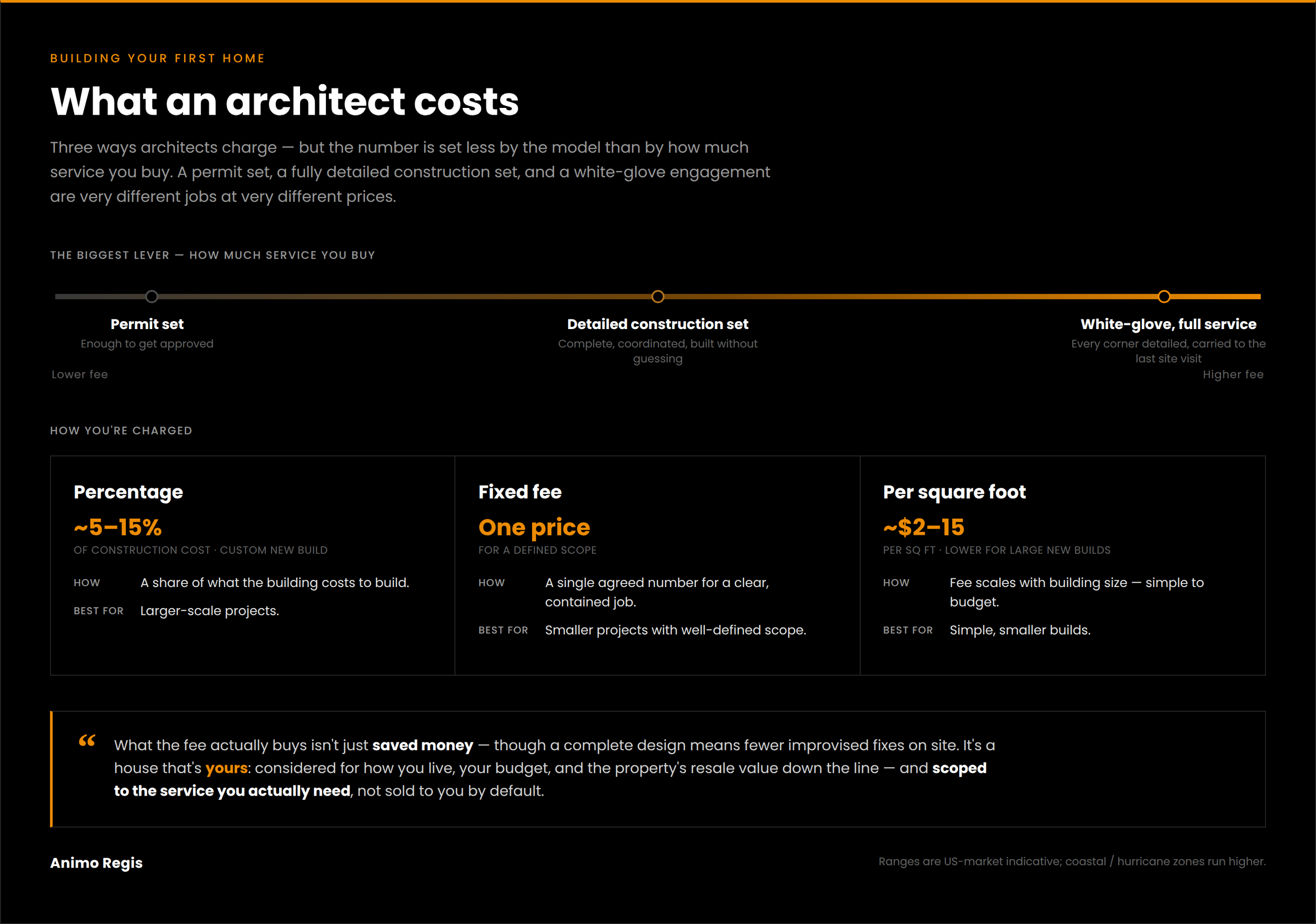
Percentage of construction cost. The fee is a percentage of what the building itself costs to build. For a custom new home, industry data puts this in the range of roughly 8–15%; renovations and additions run higher, often 10–20%, because they're more complex per dollar spent — you're designing around what's already there. Percentage-based pricing works best on larger-scale projects, where the scope is big enough that a percentage tracks the real work involved.
Fixed fee. A single agreed price for a defined scope. This works best on smaller, more contained projects, where both sides can see the edges of the job clearly enough to price it once. A basic set of permit-ready plans might run a few thousand to the low five figures; a full-service engagement on a house climbs well beyond that. The advantage is predictability — you know the number going in.
Per square foot. The fee is priced by the size of the building. Industry figures put design work at roughly $2–$15 per square foot — and, tellingly, it scales inversely with size: large custom new builds tend toward the lower end (about $2–10/sf), while small remodels and additions run toward the higher end (about $5–15/sf), because smaller and renovation work carries more design per square foot. Like a fixed fee, this model suits smaller and simpler projects and makes budgeting easy — but it's a blunt instrument, because two houses of the same size can involve very different amounts of design work. A simple rectangular single-story and a complex home on a slope can have identical square footage and wildly different real scope.
Across all three, the single biggest lever on the number is how much service you're buying — which is the part most fee comparisons miss.
What actually drives the number up or down
Two sets of factors move an architect's fee. It's worth separating them, because one is about the architect and one is about your project.
The business side:
The level of service. This is the big one. A permit set — just enough to get approved — sits at the bottom. A complete, detailed construction set is more. A high-end architect who details every junction, or a white-glove service that carries the whole project for you, is more again. You're not comparing like with like unless you're comparing the same level of service.
Project complexity. A conventional design resolves faster than an ambitious or unusual one. More design thinking, more drawings, more coordination — more fee.
How much hand-holding you need. A first-time client who wants to be walked through every decision is a different engagement from a developer who knows exactly what they want. Neither is wrong; they cost differently.
The architect's reputation. As in any field, a more established or sought-after architect commands a higher fee.
The technical side:
The site. A difficult terrain — a slope, poor soil, tight access — adds design and coordination work.
The climate. This one matters a lot in our markets. A house in the USVI, Florida, or along the Gulf Coast carries real engineering weight: high-wind design, flood and elevation requirements, coastal exposure, hurricane detailing. That work is not optional and it pushes fees toward the higher end of any range — a coastal custom home is simply more building to design than the same house in a benign inland climate.
The jurisdiction. A demanding permitting process — coastal zone review, layered approvals, tougher plan checks — adds work, and the architect's fee reflects it.
The scope. How much of the project the architect is contracted to cover, from a single phase to all of them.
The takeaway: when you see two very different fees for what sounds like "the same house," the difference is almost always hiding in these factors — usually the level of service.
What's included — and what's extra
Fee quotes vary in what they cover, so it pays to ask. As a general guide:
A set number of revisions is usually included. Most architects build a reasonable amount of back-and-forth into the fee, and many are willing to go a bit beyond it if the requests are reasonable and don't, as it were, jump the shark — turn into a redesign of something already settled.
3D renderings are usually extra. Useful, often worth it, but typically priced on top of the base fee.
Construction administration is almost always extra — a separate line, because how much of it you need varies enormously (more on this below).
Consultants carry their own fees. Structural and MEP engineers, surveyors, and specialists are generally billed separately or passed through — they're part of the project cost, not usually folded into the architect's design fee.
The phase where the money concentrates is construction documents — the detailed set — which alone can be something like 35–50% of a full architectural fee. Construction administration — the architect staying involved through the build — is the next largest, often a quarter of the fee or more. Those two are where the real cost sits, and they're also the two most worth understanding before you decide what to buy.
Trying to work out what level of service your project actually needs — and what it should cost? That's exactly what Office Hours is for: a free, focused conversation about your specific project, with an honest read on scope and budget. No obligation, no pitch.
Construction administration: the part you can sometimes scale down
Here's a piece of honesty most firm pages won't give you: not every project needs full construction administration. CA — the architect reviewing the build, answering the contractor's questions, and making the calls when site conditions and drawings don't match — can carry a large share of the total fee. Whether you need all of it depends on the project.
If you're building a house with a standard structural system, a design that isn't overly complicated, and a reputable builder you trust, CA can often be scaled down considerably — milestone check-ins rather than constant presence. But a complex, highly detailed project — or one with an unfamiliar contractor — genuinely needs it, because that's where the absence of the architect gets expensive: decisions get made on site, without the full picture, and you pay to unwind them later.
This is the clearest example of the broader point: a good architect scopes the service to your project, rather than selling you all of it by default. If you don't need weekly site visits, you shouldn't be paying for them.
So — when does the fee pay for itself?
It can. A good architect saves you money, because a complete, well-considered design means you're not improvising on site during construction — and on-site improvisation is where budgets quietly bleed out through change orders. That's real, and it's worth the fee on the right project.
But framing the whole decision as "will it save me money" misses the actual reason to hire an architect. The main reason is to get a project that works for you, specifically — someone who thinks about your needs, the way you live, the future of the property, and your money, all at once. That's the thing a stock plan can't give you and a draftsman usually won't: a design that's genuinely yours.
People skip the architect because they're afraid of the cost, and sometimes because they haven't been shown what they'd actually be getting. But the answer isn't necessarily the most expensive service — it's the right one for you. Maybe you don't need a complex schematic process. Maybe a permit set is enough. Maybe your build doesn't warrant weekly CA visits. What you get either way is a design made for you — one that has considered your budget, your family, and the resale value of the building down the line. The fee, scoped honestly, is the price of that. Viewed that way, "is it worth it" stops being about the number and starts being about whether you want the house to be yours.
If it's your first build
If this is your first project, the fee conversation looks a little different — and it should. A first-time builder gets scoped to their actual requirements, not sold a standard package. But before any of that, the first thing worth doing is simpler: demystifying the project. What you need to be aware of, where the common pitfalls are, and the issues that tend to surface down the line.
On a first build, a good architect isn't only an architect — they're also, in effect, a consultant helping you make the best possible decision, including the decision of how much architect you actually need. That conversation costs you nothing and can save you from the two expensive first-timer mistakes: overpaying for a service you didn't need, or underspending on a complex project that needed real design and getting blindsided on site.
The honest way to price a project is against the project itself — your site, your budget, and the level of service it actually calls for. If you'd like a clear read on what your project should cost and what level of service makes sense, book a free Office Hours session below. We'll demystify it, flag what to watch for, and tell you straight what you do and don't need — no obligation.