How to Choose the Right Roofing System: Flat, Pitched, and Mono-Pitched Roofs Explained
Choosing a roofing system is one of the earliest structural decisions in any residential build — and one of the most consequential. Get it wrong and you're looking at chronic maintenance problems, energy inefficiency, or a roof that fights your design at every turn. Get it right and it becomes invisible, which is exactly what a good roof should be.
This guide covers the three main residential roof types — flat, double-pitched, and mono-pitched — with a focus on what actually drives the decision: climate, budget, and the building itself.
Start with climate, not cost
The instinct is to lead with budget. Don't. A roof that's cheap to install but wrong for your climate will cost more over its lifetime than the expensive option done right the first time.
The local climate should be the first filter:
High rainfall or snowfall? You need slope. Water needs somewhere to go, and fast.
Hot, dry climate? Flat roofs become an asset — easier to insulate, and the rooftop becomes usable space.
High wind exposure? Pitch angle and structural framing matter more than material choice.
Once you've established what the climate demands, cost and aesthetics become much easier to evaluate.
Flat roofs
Flat roofs aren't actually flat — they carry a slight slope (typically 1–2°) to allow drainage. They're common in commercial construction but increasingly used in contemporary residential design, particularly in dry or moderate climates.
Where they work well:
Warm, low-rainfall climates
Urban sites where rooftop space has value (gardens, terraces, mechanical equipment)
Modern architectural styles with clean horizontal lines
Where they don't:
Heavy snow or rainfall regions — water management becomes a constant maintenance obligation
Anywhere with poor drainage infrastructure around the building
Materials: Typically rubber (EPDM), PVC, or TPO membranes. Each has different performance characteristics and price points. Built-up roofing (BUR) is an older system still used on larger surfaces.
Cost: Lower upfront than pitched alternatives, but factor in maintenance — flat roofs require regular inspection to catch pooling and membrane degradation early. The lifetime cost in a wet climate often exceeds what a pitched roof would have cost from the start.
Double-pitched roofs (gable roofs)
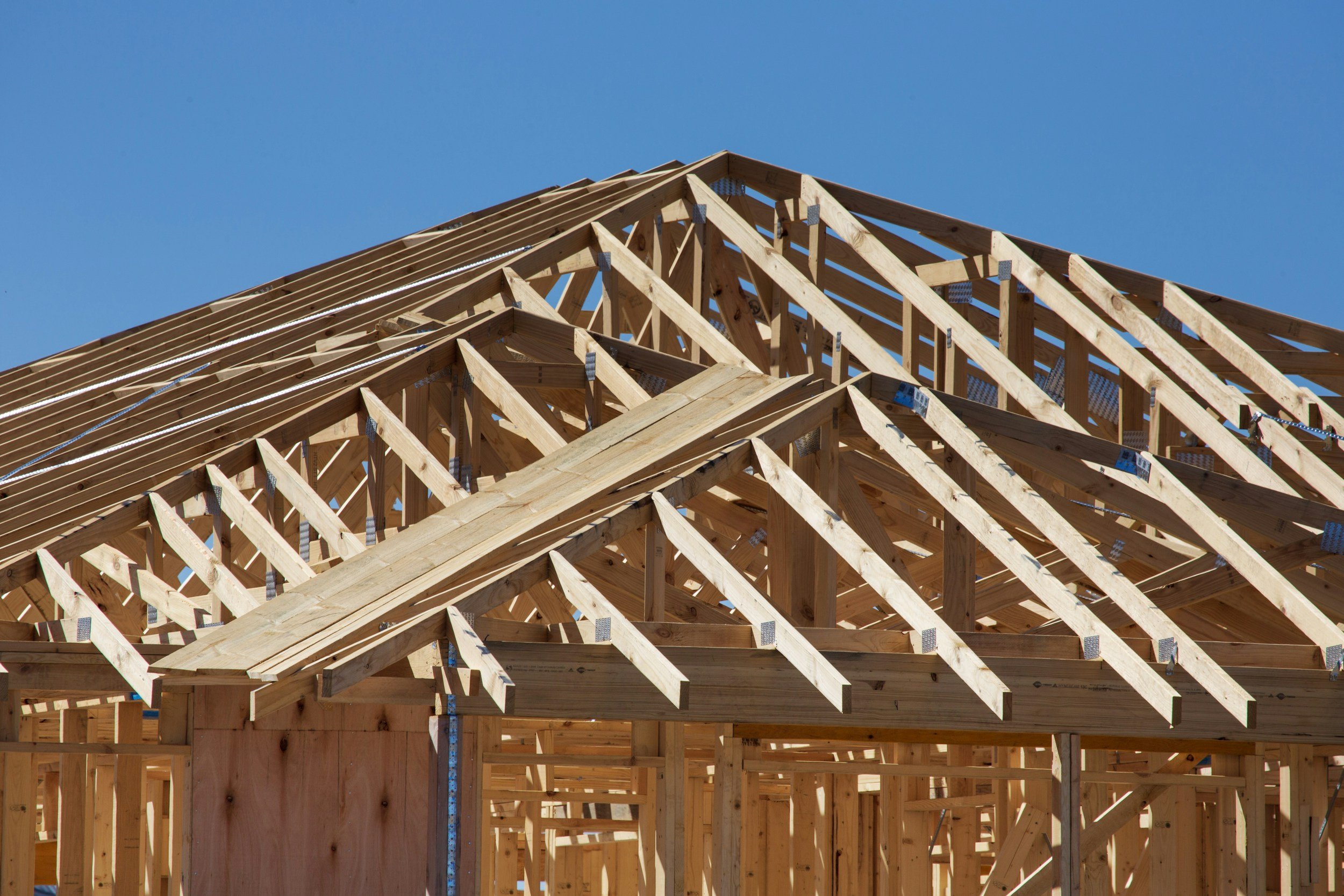
The most common residential roof form in North America and much of Europe. Two sloping planes meet at a central ridge, shedding water and snow efficiently on both sides.
Where they work well:
Climates with significant rainfall or snowfall
Residential builds where attic space or additional headroom has value
Traditional and vernacular architectural styles
Where they don't:
High-wind zones — the large gable end faces present significant wind load. In hurricane-prone areas, hip roofs are generally preferred over gable roofs for this reason.
Sites where architectural simplicity or a low profile is a design priority
Materials: Asphalt shingles remain the most common and cost-effective option. Metal, slate, and clay tile are more durable but significantly more expensive.
Cost: Higher upfront than flat or mono-pitched roofs due to the complexity of the framing. The longevity advantage is real, however — a well-built pitched roof in the right climate will outlast a flat roof by decades.
Have a roofing decision to work through before you commit to a system? Office Hours is a free 45-minute session — bring your site, your climate, and your design, and we'll work through what makes sense for your project.
Mono-pitched roofs (shed roofs)
A single sloping plane, running from a high point to a low point. Simpler to frame than a gable roof, effective at shedding water, and increasingly popular in contemporary residential design where the asymmetry reads as a deliberate architectural choice rather than a limitation.
Where they work well:
Additions and ADUs, where the mono-pitch integrates cleanly with an existing structure
Contemporary and minimalist design languages
Sites where one elevation needs to remain low (setback constraints, view preservation)
Where they don't:
High-wind areas — a large, uninterrupted roof plane can generate significant uplift forces if not properly engineered
Situations where interior volume or attic space is a priority
Materials: Same range as double-pitched roofs. Standing seam metal works particularly well with the clean lines of a mono-pitch.
Cost: Generally sits between flat and double-pitched. Simpler framing keeps costs down relative to a gable roof, though span and pitch angle will affect the final number.
The cost comparison, in plain terms
If budget is the constraint, the rough hierarchy runs: flat roof cheapest to install, mono-pitched in the middle, double-pitched most expensive. But this is a narrow view.
Total cost of ownership — installation plus maintenance plus longevity — tells a different story depending on climate. A flat roof in a wet climate will cost more over 20 years than a pitched roof installed correctly from the start.
The only honest answer: get a proper estimate for your specific climate, roof area, and material choice. A contractor's rough figure is a starting point, not a decision.
How to make the call
Four questions that cut through the noise:
What does the climate demand? Snow, rain, wind, heat — the roof has to handle all of it.
What does the design require? The roof is a major visual element. It should be a choice, not a default.
What is the full cost over 20 years? Include maintenance and likely replacement cycles.
What does the structure support? A retrofit or addition may have constraints that rule out certain systems from the start.
If you're planning a custom residential build or addition, Office Hours is a good starting point — a focused consultation before you commit to anything.