Do You Actually Need an Architect? (And When You Don't)
Not always. That's the honest answer, and it's the one most architects won't give you — because they're the ones you'd be hiring. But knowing when you don't need one is worth just as much as knowing when you do, because paying for a full architectural service on a project that didn't need it is money that could have gone into the build.
Here's the short version, and then the reasoning behind it. If you're putting up a secondary structure — a garage, a simple ADU — or a straightforward single-story home under about 2,400 square feet, in a benign jurisdiction, and you genuinely know what you're doing, you can often get there with a stock plan, a draftsman, or a capable builder, without an architect at all. Once you go beyond that — a second story, a difficult site, a demanding jurisdiction, or simply a house you want to be more than a basic job — that's when an architect starts earning their fee. The rest of this article is how to tell which side of that line your project sits on.
The quick test: which side of the line are you on?
Most of the "do I need an architect" question comes down to complexity — of the building, the site, and the rules you're building under. Stack up how many of these apply to your project:
You can often go without an architect when:
It's a secondary structure — a garage, workshop, or simple accessory dwelling unit — rather than a full home.
It's a single-story house under roughly 2,400 square feet, with a conventional layout.
The site is straightforward: flat or near-flat, good access, nothing unusual about soil or drainage.
The jurisdiction is easy to build in — a clear, predictable permitting process, no design review.
You're not in a seismic zone, a hurricane-exposed area, or a historic district — none of the conditions that put real technical or regulatory weight on the design.
And, honestly, you know what you're doing — you've built before, or you're genuinely comfortable running a self-build and reading a set of drawings.
Meet most of those, and a stock plan or an experienced draftsman may serve you perfectly well. There's no shame in it, and no architect worth their fee will pretend otherwise.
A second story is the edge. Two stories is where a project starts asking questions a stock plan can't answer on its own — how the structure carries, how the stair works, how the two floors relate. Some two-story builds are still simple enough to hand off. Many aren't. If you're at two stories, treat it as a genuine decision rather than an assumption either way.
You want an architect when:
The house is more than two stories, or complex in plan or section.
The site is difficult — a slope, a tight lot, awkward access, a view or orientation you want the house to work with rather than ignore.
The jurisdiction is demanding — layered zoning, design review, or a permitting process that punishes an incomplete or naive submission.
You're building in a seismic zone, a hurricane-exposed region, or a historic area, where the design carries technical and regulatory consequences a draftsman isn't trained to manage.
Or — and this is the one that matters most to people who end up glad they hired one — you want the house to be genuinely good. Not just built, but considered: how it feels, how you move through it, how the light works, how the money is spent efficiently rather than just spent. That's the difference between someone who draws your house and someone who designs it.
That last point is the real dividing line. Everything above it is about whether your project needs an architect to be built safely and legally. The last one is about whether you want your project to be thought about — and that's a different question, which we'll come back to.
The three people you can actually hire
Behind the "do I need an architect" question is a more useful one: what are your actual options, and who does what? There are broadly three, and they're not interchangeable.
A stock plan (or a builder working from one). The cheapest and fastest route. You buy a pre-drawn design, or a design-build contractor builds from their own catalog of plans. It works when your needs are conventional and your site doesn't fight the plan. What you give up is fit — to your site, your life, and anything specific you want. A stock plan is designed for no one in particular, which is fine right up until your lot, your household, or your ambitions turn out to be particular.
A draftsman. A draftsman takes your ideas and puts them into plans — turns what you describe into drawings a builder and a permit office can work from. That's a real, valuable service, and for a straightforward project it may be all you need. What a draftsman generally doesn't bring is the design layer: the training to think about how the whole thing works spatially, how it feels to be in, how to make the structure efficient so the build costs less. They document a design. They usually don't develop one.
There's an honest caveat here: the line blurs at the top end. A draftsman with decades of experience can deliver work that rivals an architect's on the right project — they've absorbed a lot of the judgment over the years. Outside of that exception, though, the difference is real, and it shows up in the parts of a house you can't point to but can feel.
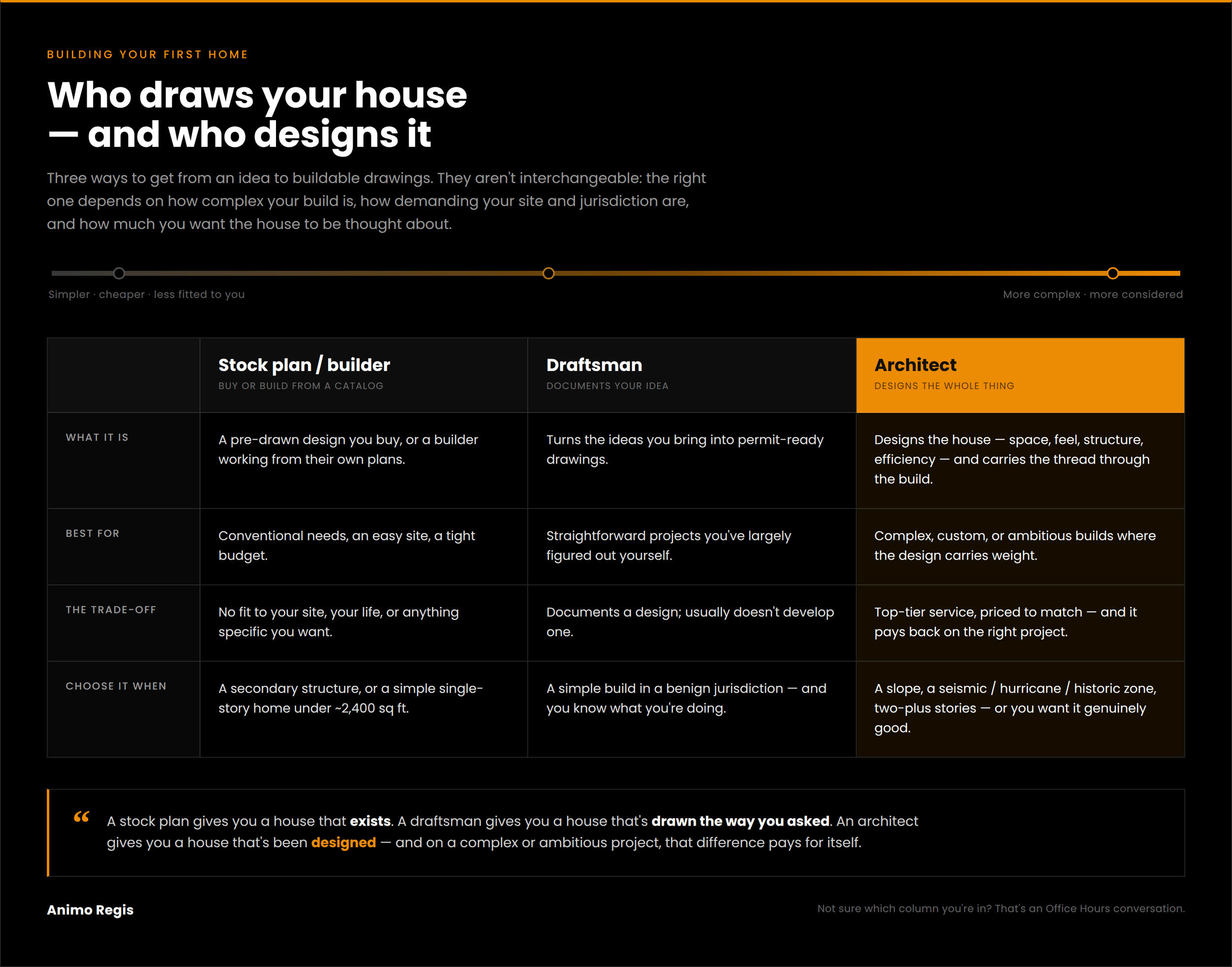
An architect. An architect carries the training to deliver a project at the highest level — and, just as importantly, spends the time to. That time is the product: thinking about the overall design, how the spaces feel and connect, how you interact with the house day to day, and how to build it efficiently so the structure itself saves you money rather than costing you extra. It's the top-tier service, and it's priced accordingly. The reason it's worth it on the right project is that the thinking done up front is worth many times its fee once you're on site — where good decisions are cheap on paper and expensive in concrete.
The simplest way to hold it: a stock plan gives you a house that exists. A draftsman gives you a house that's drawn the way you asked. An architect gives you a house that's been designed — and on a complex or ambitious project, that difference pays for itself.
Not sure which camp your project is in? That's exactly the kind of thing Office Hours is for — a free, focused conversation about your specific site, budget, and ambitions, with no obligation and no pitch. Sometimes the honest answer is that you don't need us, and we'll tell you that too.
When you genuinely need an architect — the depth
The test above sorts most projects. But it's worth understanding why certain conditions push you toward an architect, because the reasons are also what an architect is actually being paid to handle.
A sloped or difficult site. A slope changes everything — how the house meets the ground, how it's structured, how water moves around it, how you get in and out. A stock plan drawn for a flat lot doesn't survive contact with a real slope; adapting it well is design work, and design work is what an architect does.
A demanding jurisdiction. Some places make you earn your permit. Layered zoning, design review boards, historic overlays, or simply a plan-review process that bounces anything incomplete — these punish a naive submission with months of delay. An architect who knows how to prepare a compliant, complete set the first time is buying back that time.
Seismic and hurricane zones. Where the building has to resist real forces — earthquake, storm, wind uplift — the design isn't cosmetic. It carries life-safety consequences, and it interacts with structure in ways that reward trained judgment. This is core territory for an architect working with the right engineers, and a bad place to save money on the design.
Historic areas. Building in or near a historic context adds a layer of review and constraint that shapes the design from the start. Navigating it is a specialized skill, and getting it wrong is expensive.
And the quiet one: you want it to be good. None of the above may apply, and you might still want an architect — because you want a house that's genuinely considered, not just assembled. If you want someone to sit with your project and think about it, rather than draw what you hand them, that's the service you're buying. There's no complexity threshold on wanting your home to be better than the default.
What an architect actually does across a project
If you do hire one, here's what you're paying for — not any single drawing, but continuity of judgment across the whole project. On a residential build, an architect holds technical and creative accountability from the first site visit to the final walkthrough, across six phases: pre-design, schematic design, design development, construction documents, permitting, and construction administration. What varies isn't the phases — it's how many of them a given architect is contracted to cover. Full-service means all six. Partial engagement — design only, or permit drawings only — is common and legitimate. The mistake is not knowing which you've hired for, because the phases are interdependent, and the gaps between them are where projects go wrong.
Defining what you're building (pre-design). Before any design, the architect establishes a brief precise enough to design from — drawing out how you actually live, what the project has to achieve, and what the site permits — then pressure-tests it against your budget before a line is drawn. An architect who skips this and goes straight to sketching is designing without a foundation.
Turning the brief into a building (schematic design). This is where the hard spatial decisions get resolved before they become expensive to change — floor plan, massing, orientation, the relationship between inside and out. The drawings are loose on purpose; what matters is the quality of thinking behind them. A strong schematic locks in the right decisions early; a weak one defers the hard ones until they cost more.
Making it buildable (design development and construction documents). Here the role shifts to technical accountability: fixing every open variable — wall positions, ceiling heights, window sizes, materials — and coordinating structural and MEP engineers so their systems fit within the building as designed. The output is a set precise enough for a contractor to price and build from without guessing. This is where an under-resourced architect costs you the most: incomplete documents are a direct transfer of risk to the contractor, and eventually to you, as change orders. (For the full phase-by-phase breakdown, see our guide to the architectural design phases.)
Navigating approval (permitting). The architect prepares a compliant submission from the outset and sets honest expectations about timeline before submitting, not after. And a practical note that matters to the "do I need one" question: in most US jurisdictions and across the EU, a residential building permit legally requires a licensed architect's stamp. Whether that applies to your project depends entirely on where and what you're building — so check with your local authority early, because it can turn "optional" into "required."
Protecting the design during construction (construction administration). Once the build starts, the architect makes sure what gets built matches what was designed, and makes the calls when site conditions create gaps between the drawings and reality. This is the phase most often cut from residential contracts — because it feels expensive and is hard to picture in advance — and it's the one where an architect's absence tends to be felt most directly, in decisions made on site without the full picture.
The thread through all of it is continuity. Each phase constrains the next: the brief shapes the schematic, the schematic shapes the documents, the documents determine what gets built. When one professional holds that thread end to end, the project has a coherent logic. When it's cut into pieces, the project pays to reassemble that logic one problem at a time.
So — do you need one?
Put it back together. If you're building a secondary structure or a simple single-story home in an easy jurisdiction, and you know what you're doing, you may genuinely not need an architect — and you shouldn't pay for one out of a vague sense that you're supposed to. A stock plan or a good draftsman will serve you.
But if your site is difficult, your jurisdiction is demanding, you're building where storms or earthquakes make the design consequential, you're going past a second story — or you simply want a house that's been thought about rather than just drawn — that's when an architect stops being an expense and starts being the thing that protects your budget and your outcome.
The one mistake to avoid is drifting into the decision by default, either way: hiring full-service for a garage, or handing a complex, sloped, hurricane-zone custom home to a draftsman because it looked cheaper up front. Decide it deliberately, based on your actual project.
If you're genuinely not sure which camp your project falls into, that's worth a conversation. Office Hours is a free, focused session about your specific project — your site, your budget, what you're trying to build. We'll give you an honest read on whether you need an architect at all, and what full-service engagement would actually involve if you do. No obligation, no pitch. Book a session below.